Friday, January 9, 2009

No mincing words from Minc

The war of words (see last post) between the old and new regimes at Brazil's environment ministry (MMA) is turning ugly.


Having been accused by the former top official at the ministry, João Paulo Capobianco, of running an "excessively personalist" administration since he took over from Marina Silva in May last year, the present minister Carlos Minc got personal in return.

Speaking to the Estado de São Paulo where the original interview appeared,  Minc pointed out that even though Capobianco started out in the pressure group SOS Mata Atlântica, which fights to protect the what is left of Brazil's devastated Atlantic Forest, he had failed to give effect to new legislation criminalising destruction of the ecosystem - since rectified with a presidential decree late last year.

"He did not have dialogue either internally or externally, he didn't talk to Congress, nor to the productive sector," Minc said of Capobianco.

Minc also hit back at Capobianco's claim that the minister had failed to acknowledge a humiliating defeat for the environment with the agreement on a staged phase-in of low-sulphur diesel in Brazil. "Capobianco stayed five and a half years in the ministry and didn't manage to do anything to improve diesel," he said. "In seven months I got the deal. Now in the state capitals, buses and trucks are running on S-50 (50 parts per million of sulphur, as opposed to the current standard diesel content of 500ppm). And in 2012 we´ll lower the content to 10 parts per million. We're winning in stages."

As for the wider argument over the style of government and pushing the environmental agenda, Minc gave as good as he got from Capobianco.

"I'm doing exactly the opposite from Capobianco, who never discussed things with anyone. His intransigence ended up isolating minister Marina Silva. My administration works on dialogue. Inside the ministry, with the executive, with other areas of government and with the Congress."

Minc also criticised Minc's handling of the controversial breakup in 2007 of Brazil's federal environment agency Ibama, in which the old institution kept only its functions to enforce environmental legislation, while its former role of managing protected areas was given to a new body, the Instituto Chico Mendes - named after Brazil's foremost environmental martyr shot 20 years ago last month by ranchers in the Amazonian state of Acre.

At the time, the breakup was widely seen as a punishment by the government for delays in issuing environmental licenses, principally for big hydroelectric dams in the Amazon. Whatever administrative justification the new structure may have had (and there was a strong argument for reforming the previous cumbersome and under-resourced bureaucracy), the perception was of environmental defenders being emasculated in the government system, and a period of chaos followed the decision.

According to Minc, Capobianco "ended up creating a war between between Ibama and the Instituto Chico Mendes which we are only now sorting out. This war led to a five-month strike by Ibama."

The impression of a smooth transition following last year's resignation by Marina Silva - who has so far remained aloof from this squabble - is starting to look a little strained.

Copyright Tim Hirsch 2009. All Rights Reserved.


Wednesday, January 7, 2009

Outside the tent ...

The man who until May last year was Brazil's most senior environmental official has accused President Lula of lacking strategic vision on the environment.

João Paulo Capobianco left his post as executive secretary at the Ministry of the Environment (MMA) at the same time as the resignation of the charismatic environment minister Marina Silva, the former rubber-tapper's leader who had been appointed to the post by Lula when he first took office in 2002.

Capobianco, now visiting professor at Columbia University, used an interview with the leading newspaper Estado de São Paulo to criticise not just the president, but also the current environment minister Carlos Minc, accusing him of being "excessively personalist" in his administration.

As the official responsible for co-ordinating Brazil's environmental policy for six years, Capobianco was frank about its failures, especially on the question of deforestation in the Amazon. "I think we really failed to construct a more productive relationship with the economic sector - agriculture, trade, infrastructure, energy, etc," he told Estado.

"The environmental agenda cannot be the monopoly of one or other ministry - it needs to part of a vision of the State, and this vision does not exist. Is Lula sensitive to the environmental issue? Sure he is. But he does not have a strategic vision on the subject, he does not even consider it a strategic question."

Such comments are perhaps not surprising from a man who lived through constant battles with other government ministries over questions such as the licensing of hydro-electric dams, legalisation of genetically-modified soya and the special pleading of the powerful rural lobby in the Brazilian Congress. He is, after all, now "outside the tent" and free to voice the frustrations which, frankly, are felt in just about every environment ministry on the planet.

What is more unusual about the Brazilian system is that even those still inside the tent can at times be refreshingly frank about the internal struggles they face. This was Carlos Minc himself, speaking just before Christmas at a seminar on deforestation figures and quoted by the government news service Radiobras: "One ministry goes and opens up a road, another goes and builds a hydro-electric dam, and another expands the agricultural frontier. Then deforestation goes up and I'm the one who has to explain it."

Minc's undoubted dynamism and his willingness to fight the corner for the environment do not bring him much praise from Capobianco, however. In the Estado interview, he describes Minc as a friend with unquestioned commitment to the environmental agenda, but adds, "He is conducting an excessively and dangerously personalist administration. He wants in every way and at all times to give the impression that he's being a good minister and leading a good administration. This is really bad, because in truth the environmental issue is a complex one which inescapably involves conflicts."

Capobianco cites as an example the recent government decision to allow the state-run fuel supplier Petrobras a six-year phase-in period to introduce low-sulphur diesel. Minc's ministry portrayed the deal as a victory, but according to Capobianco, "It was a huge defeat for the construction of a responsible socio-environmental agenda for the country. Perhaps the biggest defeat of recent years, because it involves an environmental issue directly linked with public health and with well-recognised negative impacts."

Capobianco also criticises what he describes as Minc's "ecopragmatism" on the question of environmental licensing, mentioned in an earlier post - summarized by his phrase "dois pra lá, dois pra cá", two steps forward, two steps back. The former official says, "It doesn't work like that on environmental questions, because 'two steps back' can cause damage so serious that not even 'ten steps forward' can repair. The fact that you might receive more money to protect one cave does not minimise the loss of another. You might even lose that cave, but society needs to be clear about the consequences of that decision."

Copyright Tim Hirsch 2008. All rights reserved.

Saturday, July 12, 2008

Putting the brakes on biofuels

The worldwide reaction against rapid expansion of biofuels has continued, with a proposal by the United Kingdom government to slow down the rate at which the country’s transport fuel must increase its renewable content. The announcement follows the publication of an official review which concluded that uncontrolled use of biofuels could drive changes in land use that may increase overall greenhouse gas emissions, as well as push food prices still higher.

While the review praised Brazilian ethanol as amongst the most efficient types of biofuel, it included a case study warning that carbon dioxide emissions from producing the fuel could increase by more than 60% if sugarcane is planted in place of native Cerrado vegetation.

The reverse in British biofuels policy was a response to a report on the indirect effects of biofuels production, carried out by the head of the government’s independent Renewable Fuels Agency, Professor Ed Gallagher. It did not argue for a moratorium on biofuels, as some European NGOs are now demanding, but did say current targets in Britain and the European Union for increasing mandatory biofuel use should be revised. It said continued increases in biofuels content beyond 2013 should only proceed if it could be conclusively proven that the environment and food supply were not being compromised, either directly or indirectly.

The British Transport Secretary, Ruth Kelly, responded immediately to the report by announcing a consultation to change the current “Renewable Transport Fuel Obligation”, which sets the minimum biofuels content that UK fuel suppliers must meet. The proposal is that instead of increasing the biofuel level to 5% by 2010/11, this target should be delayed until 2013/14.

The review was commissioned by the British government as a reaction to growing international concern about the sustainability of rapid biofuels expansion, including the potential impact on the Amazon rainforest and other Brazilian ecosystems. Among the indirect impacts feared are the added pressure from increased Brazilian soya production, as American farmers switch from soya to corn to produce ethanol, and the displacement of cattle to the Amazon basin as former pasture lands in other parts of Brazil are occupied by sugarcane plantations.

The Gallagher review says the issues surrounding these possible indirect impacts are highly complex, and require much more research before they can be accurately assessed. However, it notes (not specifically about Brazil), that “the balance of evidence shows a significant risk that current policies will lead to net greenhouse gas emissions and loss of biodiversity through habitat destruction.

“This includes effects arising from the conversion of grassland for cropland.”

The British review acknowledges that the efficiency of different biofuels production methods varies greatly in terms of their CO2 emission savings, with the Brazilian ethanol system scoring very highly, especially because the waste bagasse from sugarcane plants is used in many mills to produce renewable electricity.

However, one of a series of case studies commissioned for the review warns that this efficiency could be severely compromised if large-scale sugarcane expansion takes place on land currently occupied by native ecosystems, especially in the Cerrado.

The Brazilian case study, carried out by consultant Giúlio Volpi, formerly of WWF, is critical of the government agricultural research body EMBRAPA for claiming that 71 million hectares of the Cerrado is still available for agricultural expansion, without providing information either on the biodiversity status of this land, or on the potential loss of carbon that would take place if it were cultivated.

The report goes on to quote an unpublished study which estimates that conversion of Cerrado soils to sugarcane involves the loss of around 10% of their carbon – assuming the native vegetation contained 25 tonnes of carbon per hectare, this would lead to the emission of 237 grammes of carbon dioxide for each cubic metre of ethanol produced, an increase of 63% on the current average situation.

The case study accepts the argument that the negative impacts of biofuels expansion can be very much reduced if production is concentrated on the large areas of degraded cattle pasture available, especially in former Cerrado regions. Among its policy recommendations are increases in productivity of cattle production, “agro-ecological zoning” to control the location of new sugarcane plantations (due to be announced this month by the Brazilian government), and stricter enforcement of anti-deforestation laws.

In the British government report, Professor Gallagher makes it clear he believes biofuels can potentially still play a significant role in reducing global greenhouse gas emissions. However, his call for a slowdown, and its immediate acceptance by UK ministers, are further evidence of Europe’s growing doubts about the sustainability of what was once seen as a crucial weapon in the fight against climate change.


This article was published in Portuguese on www.oeco.com. Copyright O Eco, All Rights Reserved.

Wednesday, June 18, 2008

A month of Minc

A month after the sudden and dramatic resignation of Marina Silva as Brazil’s environment minister, it is still early days to assess the performance of her successor Carlos Minc, especially as he only formally took office nearly two weeks after her departure. But if anyone thought the new man would bide his time and ease himself gradually into the controversies that prompted Ms Silva’s exit, Minc has proven them dramatically wrong.

Responding to the unplanned change of environment ministers, President Lula insisted there would be no change in government policy on the environment. One month on, it does seem that the course steered by the Environment Ministry (MMA) remains roughly in the same direction. But a very different type of captain is at the helm.

Marina Silva, while adored and almost worshipped by the environmental movement, remained a somewhat aloof figure, giving few interviews to the media, and usually choosing to fight her many battles with government colleagues behind closed doors rather than in the public spotlight.

Minc has proven to be the very opposite, a down-to-earth Carioca reluctant to swap the beaches of Rio for the dry political landscapes of Brasilia – and not even waiting for his appointment to be officially confirmed before pronouncing in public on environmental licensing, deforestation and just about any other subject he could think of. And he has barely kept his mouth shut to the media ever since.

An early indication that Carlos Minc was not going to shy away from contoversy came in a very public war of words with the governor of Mato Grosso and soya magnate Blairo Maggi – Minc anticipated the publication of the figures for Amazon deforestation in April to warn the public that they would be bad, and that Mato Grosso would once again top the list of deforesting states. The response from Maggi was less than complimentary.

Minc also burst onto the scene with a string of new ideas, including that of a national “environmental force” to strengthen protection of Brazil’s forests and other ecosystems. He has since elaborated on that to propose a contingency force of firefighters and military police, both under control of the state governors, along the lines of the national security force set up after long negotiations to deal with emergencies, including last year’s upsurge of gang violence in Rio de Janeiro. In Brazil’s complex power play between the functions of state and federal authorities, Minc is walking into a potential minefield here, and he knows it.

Add to all this new, expanded targets for protected areas in the Amazon, and a stepping up of the “Arc of Fire” operation against illegal deforesters started during Marina Silva’s time in office, and Minc has left observers almost breathless trying to keep track of his latest statement or announcement.

What is still not clear, however, is how much of the frenetic activity of his opening weeks will result in solid measures to protect the environment, and what the changeover in ministers really means for the direction of government policy. For this reason, many of those in the NGO sector are understandably reluctant to commit themselves at this stage with an opinion on Minc’s performance so far.

Another reason is that the early signals about life under Minc can seem a little contradictory. For example, according to the director of environmental policy at Conservation International, Paulo Gustavo do Prado Pereira, among the positive signals to emerge from Minc’s brief tenure is his defence of the existing Forest Code, which stipulates that in the Amazon region, landowners must leave at least 80% of their property as natural vegetation – a rule which has come under strong attack from the rural lobby in Congress, generating speculation that it would soon be changed.

On the other hand, as the Instituto Socio-Ambiental (socio-environmental institute) points out, one of the first decisions Minc made in office was in effect a concession to the rural lobby in general and to Blairo Maggi in particular, despite the bad-tempered rhetoric the two men had exchanged in public. He clarified (or weakened, depending on your viewpoint) a key anti-deforestation measure to deny credit to landowners found to have infringed environmental regulations – stipulating that it applied only to areas officially considered within the Amazon forest biome, and excluding those areas in the transition zone between the Cerrado, or savanna, and the Amazon. The practical result of this measure will be to keep the lines of credit open to many farmers in Mato Grosso, whether or not they have been observing environmental laws.

Another area in which Minc’s tendencies are difficult to read is the question of environmental approval for major infrastructure projects, perhaps the biggest single issue that had got Marina Silva into trouble with government colleagues and created the frustration which led to her resignation. It was another subject on which he pronounced before he was even confirmed in the job, saying that rigor in the assessment made of the environmental impacts of a project should be combined with much less bureaucratic procedures and a speeding up of the approval process. This had been one of Minc’s priorities as state environment secretary of Rio de Janeiro, and something he has since followed up with the new directorate of the environment agency Ibama.

According to the campaigns director for SOS Mata Atlântica (Save the Atlantic Forest), Mario Mantovani, the setting of specific targets inside which environmental licences should be issued is the one negative point so far in Minc’s performance: “These are targets that can’t be met, because there are lots of bad projects out there – so he is taking a risk here,” says Mantovani.

On the other hand, according to Mantovani, Minc is a skilled negotiator and he is broadly optimistic that he will prove a good minister – but will face the same pressures from inside government that caused Marina Silva’s downfall.

“ Minc has one great merit: he’s been in the media since the day he arrived, drawing attention to environmental issues. Now he has to show what he is able to do in practice,” Mantovani adds.

Paulo Gustavo Pereira of Conservation International is also generally positive about Minc’s period of office, although he says it is too soon to say whether he is optimistic or pessimistic. He argues that Marina Silva’s policies on conservation will continue under Minc, with Lula’s support, because “Brazil fears damage to its image abroad, and consequent damage to its agricultural business, especially biofuels.”

Minc himself gave perhaps the best clue to his style of operating when he said, early on, that his strategy was a kind of political choreography, “Two steps forward, two steps back” (in Portuguese, Dois pra lá, dois pra cá) – for example for every two licences issued, create two new parks.

For some, this is risky pragmatism, for others a good strategy for getting things done within the limits of what is possible. Whichever way, the new man attempting to steer Brazil’s environmental policy through some very rough waters should give us all an intresting ride.


This article was written for the website www.oeco.com

Saturday, June 14, 2008

Ethanol and the Invisible Ecosystem


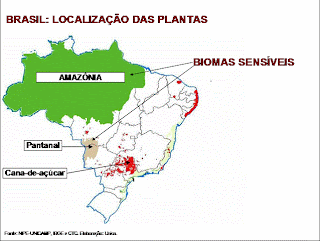
Anyone who has been following closely the recent arguments about the ethanol boom and the expansion of sugarcane plantations in Brazil will be familiar with this map. Drawn up by the powerful sugar producers’ union of São Paulo state (UNICA), it is regularly used in presentations by supporters of the industry to demolish the claim that this biofuel is threatening the rainforest.

Pointing to the “sensitive biomes” of the Amazon and the Pantanal (the largest inland wetland on Earth), the map shows that the concentration of sugarcane production and ethanol plants is a safe distance from both. It is a compelling visual demonstration, until you ask the question: what is all that white space in the middle of the map?

The answer, it turns out, is the Cerrado, or Brazilian woodland-savanna. One of the world’s 34 biodiversity hotspots as defined by Conservation International (CI), it is home to 4,400 plant species that occur nowhere else in the world, 10 threatened endemic bird species, and a range of charismatic mammals including giant anteater, giant armadillo, jaguar and maned wolf. It has also, according to CI, lost nearly 80 per cent of its original vegetation, which is why it qualifies as a hotspot (the Amazon, which has only lost some 16%, does not).

Looked at this way, the map seems somewhat less than reassuring as a guarantee of the environmental sustainability of sugarcane and its current focus of expansion in Brazil. Which is why it was a surprising choice for inclusion in a report and presentation on the industry by the Brazilian affiliate of one of the world’s best-known wildlife organisations, WWF-Brasil.

The WWF report, sponsored by the Government of the Netherlands, originally set out to analyse the expansion of the Brazilian sugarcane sector in the context of the declining subsidies for sugar production in the European Union (EU). Made inevitable because of successful challenges in the World Trade Organisation (WTO) by Brazil and others, the gradual liberalization of the sugar trade regime will allow Brazilian sugar to compete more fairly on the world market, attracting higher prices without the distorting impact of EU subsidies.

As the study developed, however, the sugar issue was overshadowed by the extraordinary boom in ethanol production, with the Brazilian sugar-alcohol industry attracting massive international interest – both positive and negative – for its unrivalled technological experience and capacity to increase production in the era of astronomical oil prices and concern about fossil fuel impacts on global warming.

In its conclusions, presented at one of a series of debates on biofuels at the University of São Paulo, the WWF report shows a curious contrast between the “headline” judgements – overwhelmingly positive – and some of the detailed analysis, which points to the need for significant strengthening of existing safeguards to prevent environmental harm and threats to food security in particular regions.

On the big picture, the co-ordinator of WWF-Brasil’s agriculture and environment policy, and principal author of the report, Luiz Fernando Laranja da Fonseca, presented an analysis which differed little from that regularly set out by the Brazilian government and by the sugar-alcohol industry itself.

Essentially, the analysis attempts to shoot down two principal “myths” about biofuels expansion in Brazil prevalent in international circles, and particularly in Europe. First, that it threatens sensitive ecosystems like the Amazon (that map appears at this point on the Powerpoint presentation), and second that it contributes to the current world food supply crisis. On the second point, the argument used is that sugarcane occupies a small proportion of agricultural land, dwarfed by crops such as maize (corn) and soya (soybeans), and that there are vast tracts of degraded cattle pasture that provide more than enough spare capacity to expand both food and biofuels production.

The WWF report argues that at this “macro” level, the negative impacts of sugarcane expansion are low, and that there are significant benefits to the climate from using one of the world’s most energy-efficient forms of biofuels production – made even more efficient by the growing use of the woody crop waste known as bagasse to generate electricity.

When it comes to potential regional impacts, however, the report paints a very different picture, especially regarding the Cerrado. It cites another report published late last year by the Institute for Society, Population and Nature (ISPN), funded by the EU. This report suggested that some of the areas currently experiencing the most rapid growth in the planting of sugarcane were also those identified by Brazil’s federal environment ministry (MMA) as priority areas for conservation of the Cerrado ecosystem.


Source: ISPN, from MMA and INPE

For example, in this map showing part of the state of Goiás to the west of the federal capital Brasilia, the purple areas of sugar cane plantations and red production plants are shown to coincide with the beige shaded areas defined by the government itself as “very high priority” areas for conservation of the Cerrado.

Even in the areas of São Paulo state where sugarcane already dominates the landscape, both the ISPN report and the current WWF study warn that further expansion of the crop could have damaging impacts on water resources and on biodiversity. For example, the region around the city of Riberão Preto – the Dallas of Brazil’s ethanol rush – some 45% of the land surface is already covered by sugarcane. Further expansion, argues WWF, should be accompanied by better strategic planning and accompanied by measures such as new protected areas to safeguard what remains of the natural resources of the area.

On the question of food security, the report also cautions that at the local level, there is a risk that small-scale agriculture, which produces the great majority of Brazil’s food supply, could give way to large-scale ethanol production, and that farmers displaced from their lands could be driven to peripheral urban areas with all the social consequences that brings.

The WWF study also acknowledges that while the direct impact on the Amazon from sugarcane production is minimal – although a small amount is grown in the region – there is a risk of indirect impacts if the displacement of cattle production and other crops in the Centre-South region by sugarcane pushes those activities to the rainforest frontier. However, it does not come to a firm conclusion on this, arguing instead that methodologies should be developed to measure these indirect impacts.

So lurking beneath the generally positive outlook on ethanol expansion given in this WWF analysis lie some pretty severe points of caution. Perhaps one of the key messages is that if the industry and its supporters really want to put a convincing case for the sustainability of this booming biofuel, the Cerrado should cease to be an invisible white gap on the map, and acknowledged as a valuable ecosystem worthy of care and attention in the planning of energy and food production in Brazil.


This article was published on www.oeco.com.br

Saturday, May 24, 2008

The passing of Marina

The sudden resignation of Brazil’s environment minister Marina Silva this week left the government of President Luiz Inácio Lula da Silva badly wrong-footed. Lula himself faced the embarrassment of having to respond to the announcement during a press conference with the visiting German chancellor Angela Merkel, and the process of naming a successor was messy and confused, with the result that the new environment minister Carlos Minc appeared to be the president’s second choice.

The prominent coverage given to the resignation, not just in Brazil but around the world, is testament to the influence and respect Marina Silva has earned during her period in office. Yet in a sense, the real surprise was not that she left the government, but that she remained inside it for so long.

At one level, Silva has been at the core of Lula’s administration. Their political association goes back more than thirty years, and when the new president took office in 2003, hers was one of the first ministerial appointments to be announced. It was a highly symbolic choice -- the charismatic leader of the rubber-tappers association from the remote Amazonian state of Acre, and former close associate of the assassinated activist and environmental martyr Chico Mendes. For the green movement, it seemed a dream come true. A child of the struggle against destruction of the rainforest was now in charge of government policies to protect it.

What was more, Marina Silva took with her into the environment ministry (Ministério do Meio Ambiente, or MMA) a group of advisers drawn from green NGOs, including a former director of Greenpeace in Brazil. On the sidelines for so long, Brazilian environmentalists now even seemed to have their own headquarters in the heart of power, one of the brutalist 1960s blocks that house the ministries marching up Brasilia’s esplanade towards the presidential palace, the Planalto.

It did not take long, however, for tensions to emerge between Silva and other members of the Lula administration. Despite his obvious affection and respect for Silva and the struggle she represents, Lula is anything but green. The former metalworkers’ union leader takes what might be termed an old-Left view of development – progress for him and the majority of his colleagues is grounded in industry, jobs and infrastructure. If trees and rivers get in the way of roads and dams, the “tree-huggers” are cast as the enemies of development.

So Marina Silva’s MMA has been in a constant series of battles with other, more powerful ministries such as Mines and Energy, and Agriculture. From the start, the ambitious multi-ministerial plan to combat deforestation in the Amazon has been caught in the contradiction of government incentives for an expanding export-based agricultural commodities sector, and a programme of roadbuilding and new hydro-electric dams in the region.

At times, Silva has had to ride out public and somewhat humiliating defeats, for example in the government decision to accept the legalization of commercial growing of genetically-modified crops. This was one of several points at which she was widely expected to resign – but she took the view that it was better to fight battles inside government so long as she could still have a significant influence.

Equally, Marina Silva was frequently among the names listed by the media as likely casualties of government reshuffles, most notably when Lula began his second four-year term at the beginning of 2007. The complaints against her ministry were growing louder from industrial lobbies that saw the environmental licensing system as a major constraint holding back big developments – a serious charge from the point of view of a president grounding his second mandate on a “Programme of Accelerated Growth” in which environmental concerns are often portrayed as an inconvenient handicap.

Yet Lula kept his environment minister on, probably because in the end it was better for him to have her there than outside the government, despite the complaints. It brings to mind the words of the late US President Lyndon Johnson with regard to the FBI chief J Edgar Hoover – “I’d rather have him inside the tent spitting out than outside the tent spitting in.” Actually he did not use the word “spitting”.

So long as Marina Silva was inside the government tent, criticism of the Lula administration’s environmental policy was always going to be muted, because green groups felt they had a powerful ally with unquestioned integrity doing her best to fight their battles from within. Lula knew this, and even if her presence could be inconvenient at times, it was a price well worth paying if she could deflect the full force of that criticism, especially on the international scene where she commanded such obvious respect.

In recent months, however, Silva’s position looked increasingly uncomfortable as Lula seemed at times to be undermining her position in public. This was clearly the case following the publication in January of the alarming satellite data indicating a sharp upturn in Amazon deforestation in the final months of 2007. While Marina Silva headed the press conference announcing the figures and blamed the expansion of cattle and soya production, Lula appeared to side with his political ally Blairo Maggi, governor of the state of Mato Grosso and big-time soya producer. Maggi accused the government space research institute INPE of lying about the data – and while Lula did not go that far, he did attack critics for jumping to conclusions about the figures, and called on NGOs to “go back and plant trees in their own countries.”

Even though the government has announced significant action this year to act against deforestation, Marina Silva has seemed increasingly marginalized. This was painfully the case last week when she was passed over for overall control of the government’s Sustainable Amazon Programme – with the coordination instead being given to the minister of strategic affairs Mangabeira Unger. Significantly, this programme puts the fight against illegal deforestation and protection of biodiversity behind guaranteeing national sovereignty and territorial integrity in its list of priorities.

With her departure, Marina Silva could make president Lula’s life very difficult, if she so chose. With a platform in the Senate, and a formidable reputation both inside Brazil and abroad, any direct criticisms she makes will be widely heard and respected. And from now on, the environmental movement will not pull any punches.

In fact, her first public statements following her resignation were measured and fell short of open criticism, speaking only of a sense of “stagnation” in her ability to influence things, and wishing well to her successor. But in a sense, she did not need to attack government policy, since the very act of her resignation had been so widely interpreted as a blow to the credibility of Lula’s environmental policies.

The new minister Carlos Minc, until now environment secretary for the state of Rio de Janeiro, has fine credentials as far as the green movement is concerned – he was, for example, among the founders of the Green Party in Brazil. However, he suffers from one major disadvantage. He is not, and never will be, Marina Silva.


This article was first published in O Eco.


Sunday, May 4, 2008

Ports, parrots and Indians


It is a classic tale of David and Goliath. A handful of Tupi-Guarani Indians, backed up by ornithologists concerned about some rare parrots, taking on Brazil’s richest man and his plan to construct the biggest port in Latin America.

That, in caricature, is the battle currently under way over proposals by the mining and logistics entrepreneur Eike Batista and his LLX company to build a R$6bn (US$3.6bn) mega-port, known as Porto Brasil, on the Atlantic coast South of São Paulo.

The battle also represents an important test of the seriousness with which the Brazilian decision-making process, in all its complexity at local, state and federal levels, values what remains of the unique coastal ecosystems that have felt the onslaught of 500 years of development since the arrival of the Portuguese in Brazil.

First, a bit of background. The proposal is for a massive container port to take pressure off the one at Santos, currently Latin America’s busiest. The huge queues of trucks which build up at Santos and at the next major port to the South at Paranaguá, are seen as damaging bottlenecks to Brazil’s trading infrastructure, which will become increasingly serious as the country’s economy grows.

Porto Brasil would include an offshore island with 11 berths capable of loading deep-draught vessels, the largest of which are currently unable to access Brazilian ports. Onshore, the main loading area of six square kilometers would handle up to four million standard freight containers (TEUs) a year. Behind the port itself, a 13 sq km industrial zone would house auto and electronics factories, food processing units and other “high value-added” industries, according to the publicity of the port’s proponents.


Looking at the location of the proposed port on Google Earth (see illustrations) helps to illustrate both the attractions of the Porto Brasil project and the reason it is causing such controversy. It would fill in the only remaining patch of green along the continuous strip of beachfront urban sprawl, stretching for some 100km from Santos to the mountains of the Jureia-Itatins protected area, one of the most important remaining sanctuaries of the Atlantic Forest.

Apart from its proximity to the economic powerhouse of South-East Brazil and its agricultural hinterland, the port and its promised jobs (30,000 during construction, 5,000 permanent) holds obvious appeal to a region which depends for its income on the seasonal disgorging of the mega-city of São Paulo, 700m up on the plateau, to its nearest coastline during the summer holiday periods.

The municipality of Peruibe, within whose boundaries the port is planned, has grown rapidly in recent years largely through development of holiday homes and gated communities which remain empty for much of the year.

The mayor of Peruibe’s special adviser, Sílvio Siqueira Junior, explains, “We have a serious problem in Peruibe today, which is that it survives on the season, the veraneio (summer vacations). In practice, we’ve got the period from December to February, when the place is crowded with tourists – and for the rest of the year, traders have to survive on the business they do during that season.

“We believe that an enterprise on this scale will make a whole series of other businesses possible, which at the moment are unviable in Peruibe and the surrounding region.”

Siqueira admits, however, that “there are more questions than answers” surrounding the detailed proposals for the port, not least of which is the environmental impact it would have.

That little patch of green, as it appears from a satellite photo, is in fact highly significant in the mosaic of varied and contrasting habitats which are collectively referred to as the Atlantic Forest (or Mata Atlântica in Portuguese), the ecosystem that once stretched in a continuous swathe along the entire Eastern coast of Brazil, and inland as far as Paraguay and Northern Argentina – but which has lost at least 93% of its original extent.


One of the reasons that the region holds an exceptional variety of plant and animal species (it is classed as a Biodiversity Hotspot by Conservation International) is that the landscape rises rapidly from sea level to the mountain range known as the Serra do Mar, giving rise to an inter-connected series of habitat-types, each with its own unique set of species.

Among the most threatened of these habitats is the restinga , the term used for the forest growing in the white sands of the coastal plain, often in a very narrow strip between the tidal zone and higher ground. Plants in these areas have evolved specific survival strategies to deal with low levels of nutrients and soil moisture, and they have their own characteristic flora such as ground-growing bromeliads and stunted trees.

By their nature, restinga forests tend to be in the way of coastal developments seeking flat land near a beach, and the zone proposed for Porto Brasil is one of the very few places where there is a continuous undeveloped area linking the mountains to the ocean.

Its importance has been emphasized recently by the discovery of a colony of an endangered parrot species, the Red-tailed Parrot (Amazonas brasiliensis), whose entire global range consists of a small strip of coastline barely 200km in length, and which has suffered badly from habitat loss and capture for the pet trade.

The colony of around 150 individual parrots is thought to be the northernmost outpost of the species, and at least one of its “dormitories” – the collective roosts where the birds gather at dusk for mutual protection – is in the very area that would form part of the industrial zone in the current plans for the port.


The presence of the parrots, together with several other species unique to the coastal lowlands of the Atlantic Forest, has led the respected international NGO Birdlife International to include this location in its global network of Important Bird Areas (IBAs), places deemed to be priorities for conservation.

The ornithologist and bird guide Bruno Lima, who regularly brings foreign birdwatchers to this site, comments, “If we lose it, we lose it forever. It’s the last great important area on the São Paulo coast. People love this area, they come here to see the birds and nature.

“We really need this area, it’s very important. More than we know.”

The company wishing to develop the port, LLX, insists that it places a high priority on environmental responsibility, and that before the project goes ahead there will be a full assessment of the flora and fauna, impacts on the coastal ecosystem and other requirements of the public authorities that would license the project.

Those studies have yet to be carried out, but in the meantime a more immediate obstacle needs to be overcome by the port developers. Around 50 families of Tupi-Guarani Indians currently occupy parts of the area proposed for the port, among the very few indigenous people still claiming rights to Brazil’s coastline from which they were displaced by the European settlers from the 16th century.

The company claims these Indians are effectively squatters who only arrived on the land eight years ago, and they have offered alternative homes to the families on a nearby estate – together with other incentives such as a 4 x 4 Mitsubishi vehicle for the use of the community. The issue has split the families, with the majority accepting these terms and a smaller group determined to stay.


The local office of the federal indigenous affairs agency Funai has compared these tactics with those of the Portuguese 500 years ago, offering trinkets like mirrors and hairbrushes to the original inhabitants of Brazil in return for land. The agency is attempting to get the land officially demarcated as Indian territory – if this is approved by the government in Brasilia, it will be virtually impossible for the port to proceed. A public meeting on the proposal was suspended in March when federal prosecutors gained a court injunction claiming it was premature to proceed with formal consultations on the port while the question of the Indians was unresolved.

So it is still not clear whether the environmental importance of the site will be fully put to the test. Another obstacle has arisen with proposals from the São Paulo state government to create a new marine environmental protection zone along this coast – while mainly directed at control of commercial fishing, it could complicate the licensing of the port.

If the port developers get past these other hurdles, the municipality of Peruibe would still need to change its own local zoning plan, which currently prohibits development on the restinga forest. That in turn will give rise to a fierce local debate about what type of development is appropriate for the region.

According to Plínio Melo from the NGO Mongue, which campaigns for conservation of coastal habitats and traditional communities in the area, Peruibe should concentrate on its unique assets.

“Metal-works, cement plants, the auto industry, you can find those anywhere in the world,” says Melo. “But only we have this preserved Atlantic Forest, no one else has got it any more. So any type of investment should be based on that regional vocation – in other words, environmental and ecological tourism.”


This article first appeared on the O Eco website. Copyright Tim Hirsch, 2008. All rights reserved.